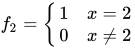
הזזה אופקית 📥 הורד PDF עכשיו תורכם:יהי R R {\displaystyle \mathbb {R} ^{\mathbb {R} }} . נבחר f ∈ R R {\displaystyle f\in \mathbb {R} ^{\mathbb {R} }} . נגדיר סדרה אינסופית של פונקציות f 0 , f 1 , . . ∈ R R {\displaystyle f_{0},f_{1},..\in \mathbb {R} ^{\mathbb {R} }} באופן הבא: f i ( x ) = f i − 1 ( x ) {\displaystyle f_{i}\left(x\right)=f_{i-1}\left(x\right)} לכל x ∈ R {\displaystyle x\in \mathbb {R} } . האם { f 0 , f 1 , . . . } {\displaystyle \left\{f_{0},f_{1},...\right\}} בת"ל? אם הקבוצה ת"ל, נמצא n {\displaystyle n} מינימלי כך ש- { f 0 , . . , f n } {\displaystyle \left\{f_{0},..,f_{n}\right\}} ת"ל. תרגיל 1: נגדיר סדרה סופית כך ש- f i ( x ) = x {\displaystyle f_{i}\left(x\right)=x} אז סדרת פונקציות הזזה יהיו f 0 ( x ) = x {\displaystyle f_{0}\left(x\right)=x} ו- f 1 ( x ) = f 1 − 1 ( x − 1 ) = f 0 ( x − 1 ) = x − 1 {\displaystyle f_{1}\left(x\right)=f_{1-1}(x-1)=f_{0}(x-1)=x-1} וכן הלאה, f n = x − n {\displaystyle f_{n}=x-n} קיבלנו סדרה אינסופית של פולינומים ממעלה 1 {\displaystyle 1} , כלומר f i ∈ R [ x ] ≤ 1 {\displaystyle f_{i}\in \mathbb {R} \left[x\right]_{\leq 1}} ולכן המ"ו הוא ממימד d i m = R [ x ] ≤ 1 + 1 = 2 {\displaystyle dim=R[x]_{\leq 1}+1=2} { f 0 , f 1 , f 2 } {\displaystyle \left\{f_{0},f_{1},f_{2}\right\}} ת"ל מפני ש { f 0 , f 1 } {\displaystyle \left\{f_{0},f_{1}\right\}} בת"ל עם n = 2 {\displaystyle n=2} , ולכן הקבוצה ת"ל מינימלית. תרגיל 2: f ( 0 ) = 1 {\displaystyle f\left(0\right)=1} ו- f ( x ) = 0 {\displaystyle f\left(x\right)=0} לכל x ∈ R {\displaystyle x\in \mathbb {R} } כאשר x ≠ 0 {\displaystyle x\neq 0} אז סדרת פונקציות הזזה יהיו f 0 = { 1 x = 0 0 x ≠ 0 , < m a t h > f 1 = { 1 x = 1 0 x ≠ 1 {\displaystyle f_{0}={\begin{cases}1&x=0\\0&x\neq 0\end{cases}},<math>f_{1}={\begin{cases}1&x=1\\0&x\neq 1\end{cases}}} , f 2 = { 1 x = 2 0 x ≠ 2 {\displaystyle f_{2}={\begin{cases}1&x=2\\0&x\neq 2\end{cases}}} וכן הלאה </math> נוכיח שהקבוצה בת"ל:יהיו c 1 , . . , c n ∈ R {\displaystyle c_{1},..,c_{n}\in \mathbb {R} } כך ש- c 0 f 0 + . . . + c n f n = 0 {\displaystyle c_{0}f_{0}+...+c_{n}f_{n}=0} .נרצה להוכיח שהצירוף טריוולי כלומר c 0 = c 1 = . . . = c n = 0 {\displaystyle c_{0}=c_{1}=...=c_{n}=0} לכל k ∈ N ∪ { 0 } {\displaystyle k\in \mathbb {N} \cup \{0\}} אז לכל 0 ≤ k ≤ n {\displaystyle 0\leq k\leq n} נציב x = k {\displaystyle x=k} ונקבל : c 0 f 0 ( k ) ⏟ 0 + . . . + c k − 1 f k − 1 ( k ) ⏟ 0 + c k f k ( k ) ⏟ 1 + c k + 1 f k + 1 ( k ) ⏟ 0 + . . . + c n f n ⏟ 0 = 0 {\displaystyle \underbrace {c_{0}f_{0}(k)} _{0}+...+\underbrace {c_{k-1}f_{k-1}(k)} _{0}+\underbrace {c_{k}f_{k}(k)} _{1}+\underbrace {c_{k+1}f_{k+1}(k)} _{0}+...+\underbrace {c_{n}f_{n}} _{0}=0} . כל המקדמים הם אפסים ולכן c k f k ( k ) = 0 {\displaystyle c_{k}f_{k}(k)=0} וכך נמשיך לכל סקלר ונראה שווה לאפס מקור: ויקיספר העברי · רישיון CC BY-SA 4.0 · התוכן עובד והותאם השיעור הקודם → המרחב של העתקות לינאריות ← השיעור הבא המרחב הדואלי

 . נבחר
 . נגדיר סדרה אינסופית של פונקציות
 באופן הבא:
 לכל
 . האם
 בת"ל?
 מינימלי כך ש-
 ת"ל.